In most industries, you’ll see this recurring pattern:
- Number 1 has twice the market share of Number 2.
- Number 2 has twice the market share of Number 3.
- And so on...
Often, the first most popular to arrive on the market takes the lead.
So you have 3 options:
- Be the first to enter a new market.
- Establish a strategy to become number 1 or number 2.
- Be seen as the only viable option for a specific problem.
Here, we’ll talk about (3) being seen as the only viable option and (1) being the first to enter a new market. We’ll learn how to choose the right market and create a category where you’ll be seen as the only viable option.
After reading this, you’ll wonder why you didn’t do this sooner.
1. The Starving Crowd
There’s a market out there that desperately needs your skills and services. That’s the “right” market. We need to find it so we can position our business on it.
Our only rule is: Don’t get romantic. Don’t get idealistic. Be pragmatic.
Our business should serve people who can pay us what we’re worth and meet our specific criteria. That’s all there is to it.
It’s all about choosing the right audience. No need to engage in a crusade or remake the world here. Reality is as it is. Let’s use that.
To find our ideal market, we need to focus on 4 critical criteria:
- pain
- purchasing power
- ease of targeting
- growth potential
Respond to Pain
The pain is the pitch.
The price you can charge is proportional to the intensity of the pain your targets feels.
When they hear about the solution to their problem or when they hear about their life without it, they should be instantly seduced by your solution.
Purchasing Power
Make sure your targets have the money, or access to the money, to afford your services at the prices you’re selling them at.
If you don’t check this box, it’s not worth your time.
Note to the “but I wanna help the world” people:
Being a good samaritan for more than two days is hard for humans, even more so if you don’t have money. Even Jesus died trying, and the guy had powers. You don’t.
It is hard to help the world for free AND make your business stay alive at the same time. But there is one thing you can do to help people for free.
Produce lots of content:
- It’s free to watch.
- It helps people solve their problems on their own.
- It helps your business to get known.
- It helps people who want to pay for your help to throw money at your face.
Easy to Target
Make things easy for yourself by looking for markets that are easy to target because ... why bother?
Life’s already hard. Don’t make things harder for nothing.
You have nothing to prove.
Growth Potential
Growing markets are like tailwinds. They make things happen faster.
Declining markets are like headwinds. They make all your efforts more difficult.
If you don’t check this box, forget the market. It will slow you down.
Choosing A Viable Market
To choose the right market, you can follow these steps:
- List all the markets you think of.
- Rank them.
- Reduce the list to the smallest possible selection.
- Select the right one by comparing the last survivors.
1. Listing Protip
When listing the possible markets, you’ll see that they inevitably fit into one of 3 buckets:
- Health — Enhance the health of your customers
- Wealth — Create wealth for your customers
- Relationships — Enhance the relationships of your customers
Attaching one of these three labels to the markets you list will help you filter them down.
2. Ranking Them Protip
Rank them by “number of criteria met”:
- Is it in pain? Yes ⇒ +1
- Is it growing? Yes ⇒ +1
- Is it easy to target? Yes ⇒ +1
- Do people have the purchasing power? Yes ⇒ +1
The higher the number, the higher it should be in your list.
3. Reducing Protip
Keep only markets meeting the 4 criteria.
Otherwise, you’re doing a bad job.
To motivate you in NOT doing a bad job:
People who share your idea and do this right will crush you.
4. Selecting Protip
In the list of survivors, select the one you like most AND that you’re the most capable of serving.
2. Niching down.
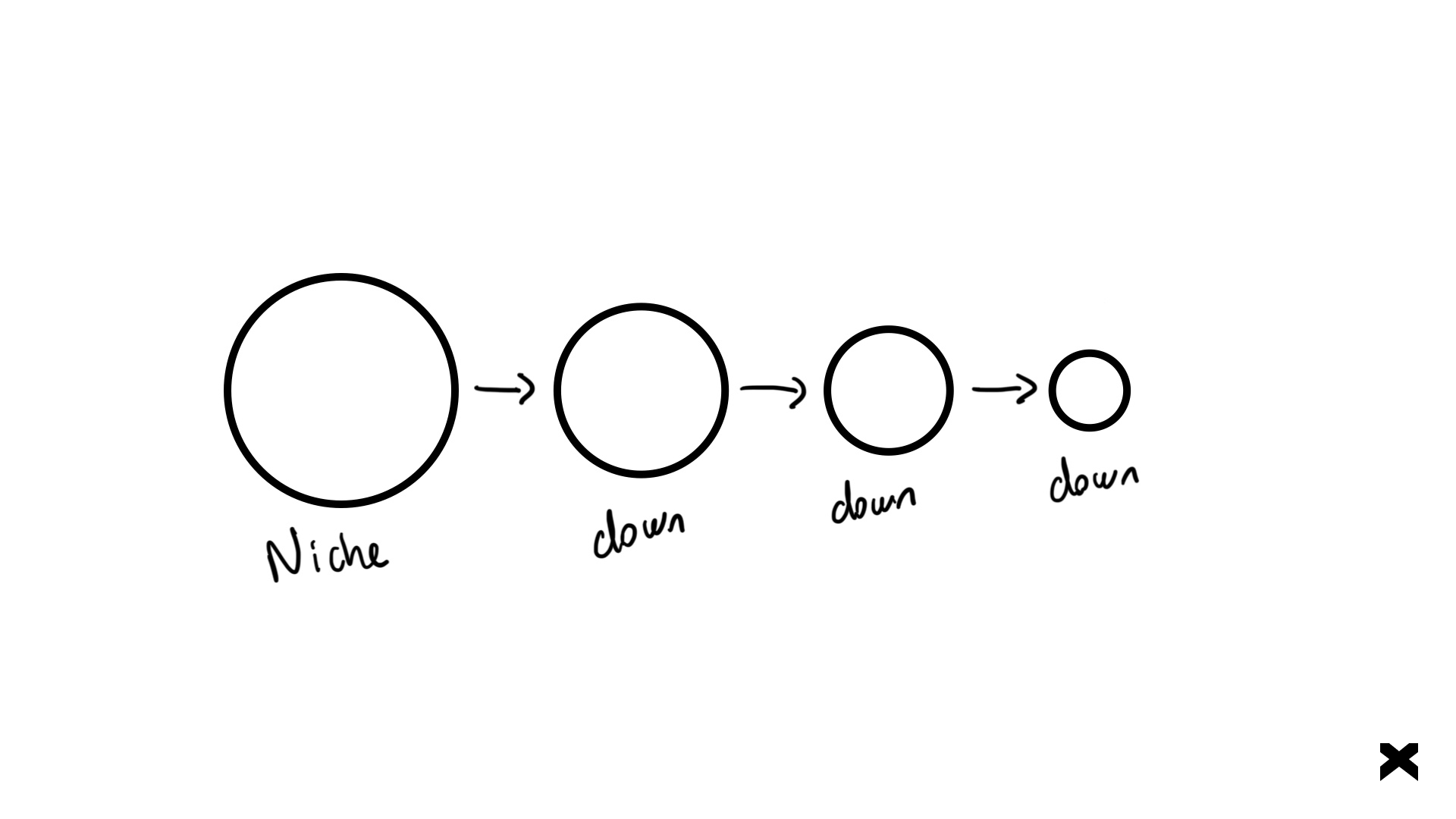
You need to “niche down” by at least 3-4 levels.
Choosing a specific niche for your business will force you to make much more money. You can sell specific products and services at much higher prices than generic ones.
Here’s a simple example:
“Time management course”
Too generic ⇒ $
“Time management course for B2B outbound sales representatives specializing in the sale of electronic products”
Specific enough ⇒ $$$$$
Same course. Totally different price.
Side note: The benefit is even more huge for digital products. You can forget about developing custom features for different customers with different needs. Your “custom development” becomes a generic use case for your service.
To find your niche, we need to start by asking ourselves:
- With and for whom do you really like to work?
- With whom does the brand best connect naturally?
Enjoy!